Remember when dropping $70 on a new video game meant you actually owned it?
For decades, the lifecycle of a game was straightforward: you bought a physical disc or cartridge, played it, and then held a tangible asset. You could lend it to a friend, trade it in for store credit, or sell it on the secondary market. That massive, organic aftermarket of used games did a lot of heavy lifting for us as consumers. It forced publishers to compete with used copies of their own games, naturally driving prices down over time.
Today, that reality is vanishing. The industry is aggressively phasing out disc drives in favor of digital-only storefronts, pitching the shift as a “modern leap forward in convenience.” But if you look closely at the math, it isn’t about saving you a trip to the store—it’s a calculated transfer of wealth from your wallet directly into the pockets of a corporate oligopoly.
The Vanishing Aftermarket
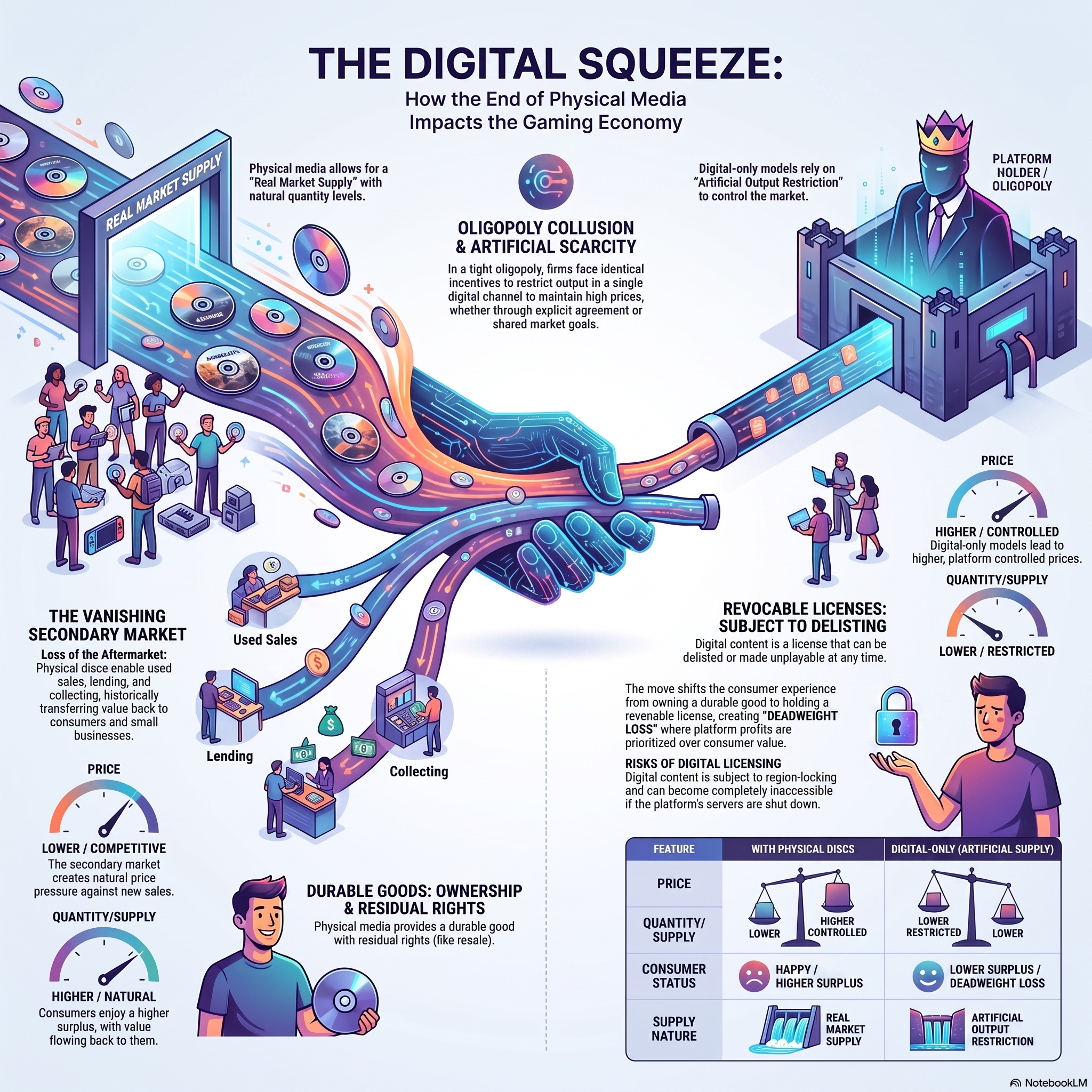
What’s Happening Here: As the infographic illustrates, physical media flows freely, creating a vibrant secondary market of used sales, lending, and collecting that naturally benefits the consumer (the “Real Market Supply”). However, by forcing players into a digital-only pipeline, platform holders eliminate the secondary market completely. Without millions of used games competing against new ones, publishers no longer face natural price pressure. They become the sole dictators of a game’s value, resulting in higher, strictly controlled prices.
Question: As a gamer, when did you first notice this shift happening, and how has it changed your own buying habits?
My Take: I noticed it before it fully arrived.
Xbox began charging for online play. PlayStation followed. Then came the DLC era—extra maps, extra modes, extra fees. Digital-only releases were still clunky and inefficient, but the direction was clear. I was already downloading custom rosters for Madden and NBA Live, built by other people to recreate eras like the ’92 Bulls. The games themselves were becoming shells that required constant connection or additional purchases to feel complete.
Before that shift, I operated in a different economy entirely. I rented from Blockbuster or Hollywood Video for six dollars a week. I bought used games at yard sales and GameStop—games I would never have paid full price for new. That’s how I discovered Duke Nukem.
Physical discs gave me options that felt like actual ownership. If I beat a game or didn’t like it, I could sell it for close to what I paid. Buy new, sell used, absorb a twenty-dollar loss if necessary. When I sold my Xbox, I sold the entire library with it as one package. The value stayed with me.
Digital purchases never offered that same utility. I’ve bought digital games, but only when the price reflected how little I was actually getting. The Last of Us seasons were good and cheap. Halo Wars for eleven dollars. I bought them because they weren’t worth much to begin with.
In economics, it’s called **“Price Inelasticity of Demand”**It was an assymetrical bet—the price was so low that the lack of ownership didn’t sting. What I was really purchasing was temporary access, not a thing I could keep, resell, or fully control.
The same problem existed with always-online titles like Elder Scrolls. I enjoyed the game, but the experience required permission to continue. I come from a time when the whole game lived on a disc you could hold, lend, or sell without asking anyone.
The people making games in that earlier era weren’t primarily trying to extract recurring revenue. It was more about building something fun and complete. A bunch of nerds creating systems you could actually own.
The current model treats the player as a recurring revenue stream instead of a customer who buys a finished product. That’s the real shift I felt—not just in price or convenience, but in what “buying a game” even means anymore.
I hope we get back to something closer to the old way. Not out of nostalgia, but because ownership created a different relationship to the thing itself.
The Economics of Artificial Scarcity
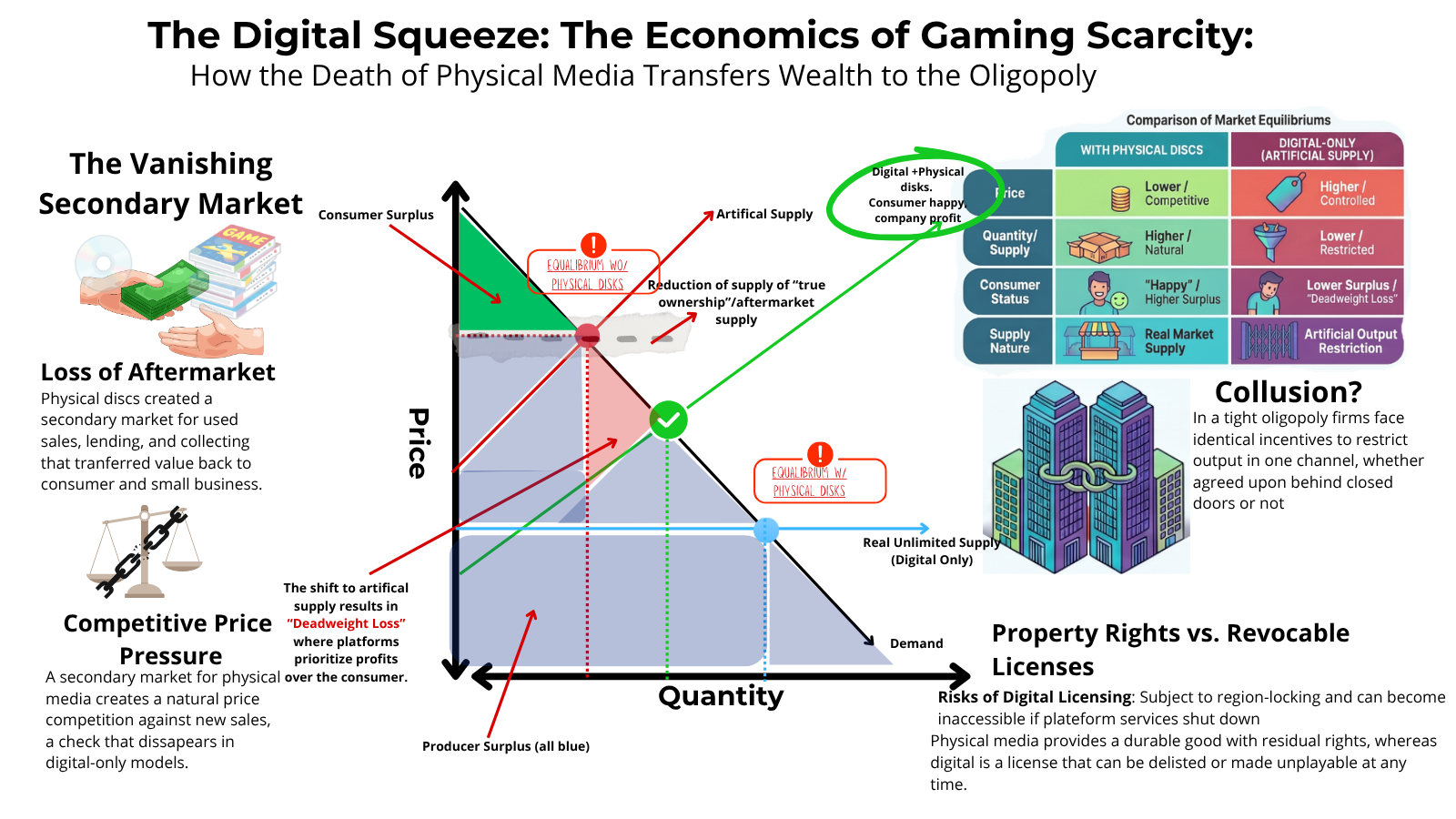
What’s Happening Here: This is where the microeconomics gets real. This supply-and-demand graph compares the old physical market to the new digital one:
- The Green Triangle (Consumer Surplus): In a physical market, this represents your “win”—the economic value you get when you find a game for a price lower than your absolute maximum budget.
- The Shift to Artificial Supply: When the platform deletes the secondary market, they pull the supply line backward. They aren’t running out of digital copies; they are creating artificial scarcity to lock down the price.
- The Red Triangle (Deadweight Loss): When the market is restricted, your consumer surplus shrinks, and corporate profits expand. The red triangle is pure economic waste—value completely lost to the market because of corporate inefficiency and greed.
Question: The companies claim going digital is all about “convenience” and “saving space.” Do you think that convenience is ever actually worth trading away this much economic value?
My Take: There’s a pattern forming inside the larger shift to digital. Companies are using the language of empathy and convenience to justify changes that actually move economic value away from the consumer and toward themselves. They call it making things “lighter” or “easier.” What they’re really doing is removing handles, options, and aftermarket value.
I saw it clearly with a water dispenser I bought from Sam’s Club. It was cheap and functional. Then they introduced a new 4-gallon jug designed to fit their dispenser—and they removed the handle. Their stated reason was that it would be lighter and reduce stress on the customer. Not long after, while I was sampling food on a Sunday morning, a salesman asked if I wanted to sign up for Sam’s Club water delivery.
That’s when it clicked. They made the jug less convenient to carry, reduced the total volume you could reasonably store and transport, and then positioned their delivery service as the solution. Over ten years, that small design change would cost a customer real money. They weaponized empathy. They created a minor inconvenience, hid behind concern for the consumer, and captured the difference as recurring revenue.
Video game companies are running the same play. They talk about convenience, saving space, and better experiences while systematically removing the consumer’s ability to own, resell, or retain value in what they buy. I’ll still purchase cheap add-ons or upgrades that actually improve the game, but I want the base game to carry some storage of value. Give me the damn game.
This same logic creates dangerous downstream effects. If you get banned for breaking a rule in an always-online or license-based game, do you lose access to everything you paid for? Social media already operates this way. Video games are drifting toward the same model—a mix of social media control and Netflix-style access. When they take away the physical disc, they also gain the power to take away your access entirely.
Once the game lives entirely on their servers and under their terms, banning you doesn’t just remove you from the community. It can erase your purchase. That’s not a hypothetical. It’s a structural possibility the current model enables.
None of this is primarily about saving space or making life more convenient. It’s about market share, recurring revenue, and the gradual transfer of economic power. By eliminating aftermarket demand—used games, resale, ownership—companies distort the demand curve so the true market can no longer set prices. The consumer loses leverage. The corporation gains it. This is inefficient by design.
The convenience they’re selling is not worth the economic value being extracted. Not when the long-term cost includes both your money and the actual experience of owning something that belongs to you.
Property Rights vs. Revocable Licenses
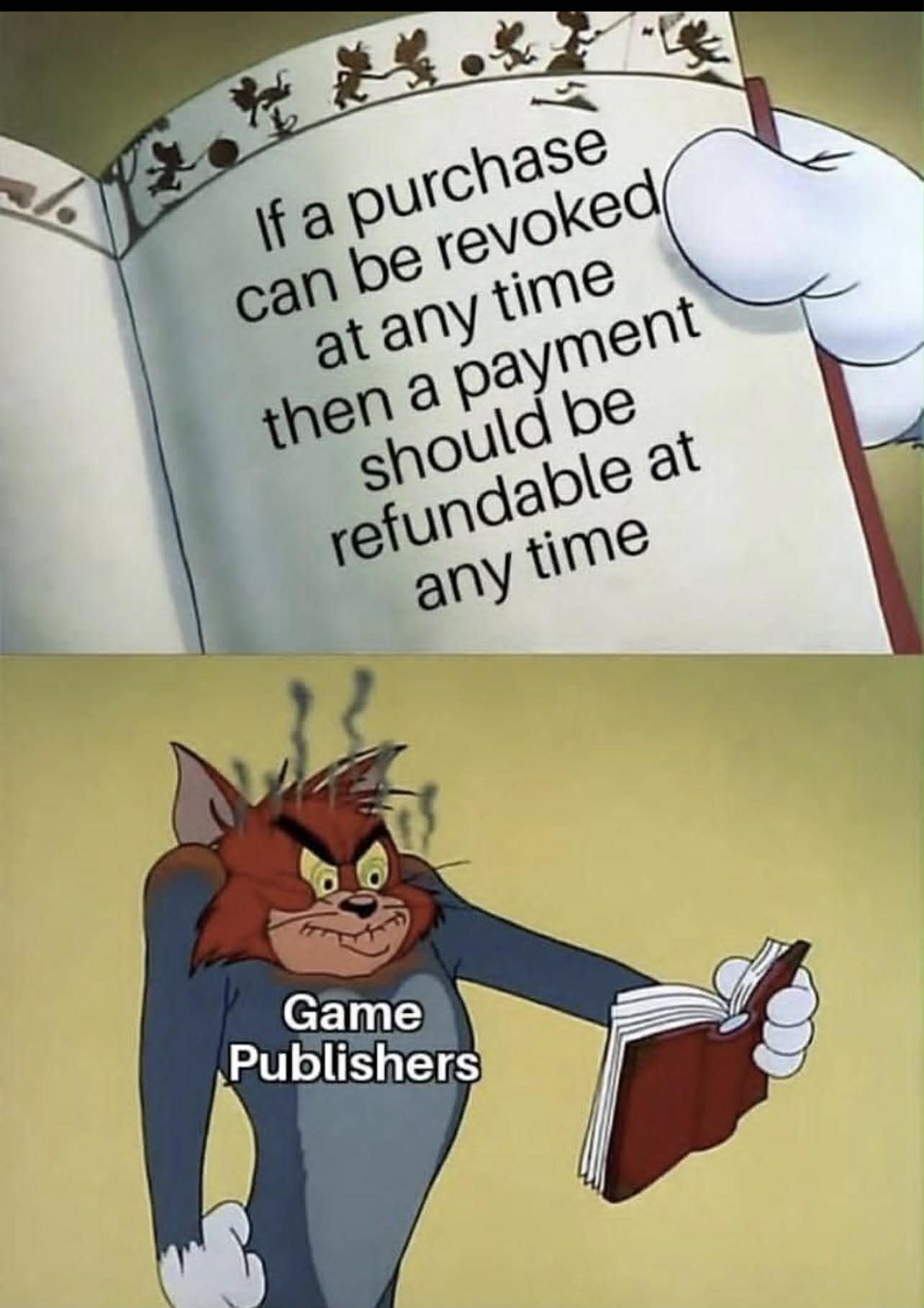
What’s Happening Here: This perfectly captures the shift in our legal rights. When you bought a disc, you bought a durable good with residual property rights. When you pay $70 on a digital storefront, you are no longer buying a game. You are purchasing a highly restrictive, revocable license. If a platform decides to delist a game, shut down its servers, or ban your account, your access is gone instantly. You carry all the risk of ownership with absolutely none of the rights.
Question: With gamers now locking thousands of dollars into digital libraries they can’t sell, trade, or guarantee they will keep, what do you think is the breaking point for the consumer?
My Take: As someone who leans libertarian, I hate to say it, but the only real pressure that can move this is antitrust enforcement and some form of regulatory boundary. The public is not disciplined enough to create that pressure at scale on its own. There was a brief moment during the AMC and GameStop events where people coordinated, but that kind of collective action is rare. Most people are already psychologically conditioned to accept the terms they’re given.
Look at what T-Mobile did with their grandfathered customers. They broke contracts that people had relied on for years. The message was clear: even explicit guarantees only last as long as they remain profitable. Once breaking them becomes more valuable than keeping them, the guarantee disappears. This is the environment digital game libraries now exist in. You can spend thousands of dollars on a collection that can be altered, restricted, or removed with little recourse.
This is the same pattern you see elsewhere. A man once went to prison for a white-collar crime after taking three million dollars. He refused to give the money back and served three years. At a million dollars per year, funded by taxpayers, the math still worked in his favor. The same logic applies to large companies. They may face initial pushback or small regulatory costs, but because they control the infrastructure and operate together, long-term extraction is almost guaranteed. The penalty is structured as a cost of doing business rather than a real deterrent.
Politicians operate under similar incentives. Insider trading that would land a regular person in serious trouble results in a two-hundred-dollar fine and a requirement to disclose the trade after the fact. It functions more like a toll than a punishment. The upside is so large and the downside so small that the behavior continues.
Consumers sit in a psychological and structural disadvantage. Marketing keeps people in a constant state of wanting the next thing, while the companies that benefit from this arrangement also influence the rules. Government intervention is difficult because any real boundary requires deciding where legitimate market activity ends and coercion begins. That line is messy, and the entities with the most resources are best positioned to argue for the version of the line that favors them.
In this setup, the consumer is structurally positioned to lose. The only consistent response is to build outside of it where possible—to create or support systems that don’t require handing over permanent economic value in exchange for temporary access.
The Ecosystem Lock-in
You might wonder how two massive competitors manage to pull this off without explicitly meeting in a dark room to collude. In economics, this is called conscious parallelism. In a tight oligopoly, companies face the exact same mathematical incentives. If one platform eliminates its physical aftermarket to lock down pricing, the other competitor finds it incredibly profitable to just mirror that behavior.
The ultimate goal is switching costs. Once you have accumulated a digital library of 100+ games tied to a single account, leaving that platform becomes unthinkable. You are completely locked in, allowing them to quietly raise prices, force you into mandatory subscription tiers just to access basic features, and squeeze out every last dime.
Question: What can we, as everyday consumers, realistically do to fight back against this digital squeeze?
My Take: Realistic pushback requires operating on multiple fronts at once, with more offense than defense. History suggests the market will eventually respond to sustained pressure, but only if consumers stop feeding the current model while also raising its operating costs.
On the individual level, the most direct action is to stop subsidizing the removal of ownership. If you normally buy five games a year, buy two. Prioritize titles you actually want and refuse to fund consoles that eliminate disc drives entirely. Support any developers or publishers still releasing physical editions, even in limited runs.
This is voting with your dollars in the most literal sense—reducing demand for the license-only model while keeping demand alive for physical media that retains aftermarket value.
That personal discipline becomes more effective when paired with systemic friction. Companies respond to rising costs. Antitrust complaints, even when they don’t result in massive fines, force legal spending, discovery, and management attention.
When piracy rises again—as it almost certainly will on PC, similar to the Limewire era—companies must spend heavily on enforcement they will never fully win. When consumers simultaneously buy less, the revenue base shrinks.
Add the cost of ongoing litigation and settlements, and the current model becomes less efficient than it appears on paper.
In that environment, producing physical discs, even in limited quantities, starts to look like the simpler and more stable option. The goal is not to destroy the industry but to make the total demolition of ownership more expensive and less profitable than preserving some form of it.
These fronts only work together. Reduced personal buying without legal and piracy pressure is easy for companies to ignore. Legal and piracy pressure without reduced consumer demand still leaves them with strong revenue. Combined, they create the conditions where returning to physical media or some form of retained ownership becomes the path of least resistance.
Here’s what you can do:
- Buy significantly fewer games: If you average five a year, cut it to two. Only spend on titles you genuinely want.
- Stop buying consoles that remove disc drives: Keep supporting the ones that still allow physical ownership.
- Buy physical when it’s available: Even in limited runs, this keeps aftermarket value alive for everyone.
- File antitrust complaints and support legal pressure: When companies clearly violate competition rules, make them spend time and money defending the model.
- Accept that piracy will rise again on PC: This is a natural market response. Don’t feed the license-only system while it’s happening.
History has repeated itself before when markets became too extractive. The difference this time is whether consumers can apply pressure on multiple fronts at the same time instead of waiting for someone else to fix it.